Sapieha’s Dinner and the Heavenly Banquet
Fr. Raymond J. de Souza on Sunday, November 1, 2026
Écoutez cet article
8 min
Given his decisive role in my priestly vocation, I pay particular attention to the anniversaries of St. John Paul the Great. We ought to call him that, as both his immediate successors argued, Pope Benedict XVI explicitly and Pope Francis implicitly.
This year’s solemn feast of All Saints marks the eightieth anniversary of John Paul’s priestly ordination, conferred by Cardinal Adam Sapieha in the chapel of the venerable residence of the Cracovian archbishops. Thirty years ago, for his golden jubilee, John Paul published a small book for the occasion, Gift and Mystery, which remains a fine gift for any priest or seminarian.
It was on his feast day – October 22, the date of his stirring “Be Not Afraid” homily at the inauguration of his pontificate – that a dozen American bishops were enticed to the White House with promises of meeting Vice President J.D. Vance and Secretary of State Marco Rubio, both Catholics. It was misleading from the outset – Vance was in Nebraska and Rubio in India – and ended in manipulation, with the White House ambushing the bishops with an Oval Office audience, during which they were filmed hovering in prayer over the president.
It’s impossible to control such things in an away game, as it were. Benedict XVI refused to allow himself to be photographed with Nancy Pelosi on one occasion, but he was in his own Vatican ballpark. But the liturgical recurrence brought to mind one of the more vivid images of John Paul’s many meetings with civil leaders.
In 1983, John Paul returned to Poland for the second time. His homeland was under martial law, declared by Moscow’s man in Warsaw, General Wojciech Jaruzelski. When the two met at the presidential palace to exchange formal addresses, John Paul was somber and serene. Jaruzelski, to the astonishment of the assembled entourages and noted by the journalists present, was shaking. Not metaphorically. His hands trembled, his knees knocked. He was afraid.
Beholding that pathetic sight, a man of great moral weakness wrapped in political power, I suspect that John Paul’s thoughts might have gone back to the “unbroken prince,” the “archbishop of the long night of occupation,” Adam Sapieha. For forty years (1911 – 1951) as archbishop of Kraków, he witnessed more blood spilled than any bishop in the history of the Church. Two world wars unfolded on his territory, which included Auschwitz.
While the influence of Poland’s “primate of the millennium,” Blessed Stefan Wyszynski, on John Paul is widely known, it is Sapieha who had the greater formative impact.
George Weigel’s biography, Witness to Hope, opens with dramatic scenes that marked Karol Wojtyła’s young years in Kraków. Amongst them is included one of the great dinners in the thousand-year history of Poland. Soon after the German-Soviet dismemberment of Poland in 1939, the Nazis installed Hans Frank as “governor general” in Kraków. The gangster took up residence in Wawel Castle, the ancient seat of Polish kings.
 Adam Stefan Cardinal
Sapieha (1867–1951)
[Source: Wikipedia]
Weigel writes that Frank, “evidently looking for some sliver of legitimation, hinted repeatedly that an invitation to dinner at the archbishop’s residence would be well-received.”
Sapieha issued the invitation and seated Frank at the other end of his formal table. He then served him, on the silver plate of the prelate’s patrimony, “the people’s diet of stale bread and ersatz coffee.” The prince-archbishop knew his people’s suffering. He thought that Frank should know it too. Years later, John Paul would remind Jaruzelski of the same.
It was in that same residence that Wojtyła completed his studies for ordination, in the clandestine seminary that Sapieha operated in his own home. It was there that he learned firsthand the lessons first taught in Kraków by the martyr-bishop St. Stanislaus nearly 900 years earlier. When John Paul stood quietly before a quaking Jaruzelski, it was Sapieha’s formation bearing fruit.
And what was Sapieha thinking that morning of All Saints in 1946? Perhaps that the young man he was about to ordain had a singular future for Kraków? Perhaps might he have been thinking about that dinner with Frank in that very building.
Frank had been in the news. A fortnight before the ordination, he had been executed, having been convicted of crimes against humanity at Nuremberg. At trial Frank was an exception, admitting his crimes and confessing that “a thousand years will pass and still this guilt of Germany will not have been erased.”
He converted to Catholicism while at Nuremberg. The American chaplain, Father Sixtus O’Connor, brought him Holy Communion hours before he was hanged. He died not defiant, as did the others, but begging for God’s mercy. Judging the sincerity of that conversion and repentance is difficult, and Fr. O’Connor, with appropriate pastoral and sacramental discretion, spoke little about it.
On that All Saints morning, did Sapieha contemplate how expansive the Communion of Saints might be? Did he consider that the man he hosted for dinner might, perhaps after 1,000 years – 10,000 years? – in Purgatory, be counted in their number? Did he permit himself the thought that perhaps his witness might have been an instrument of Divine Mercy for Hans Frank?
Frank and his fellow war criminals were executed on October 16, 1946. Thirty-two years later, Wojtyła was elected pope on that very date. If, in the unfathomable ocean of mercy, Frank was already free from Purgatory, was he interceding on that day? One recoils from the thought. It is repellent even to consider that Frank is not in Hell. But God’s ways are not our ways.
Jaruzelski, for his part, spent the post-communist years attempting to justify his actions as those of a true Polish patriot. It was not convincing, but something convinced the old tyrant instead. Before his death in 2014, he asked for a Catholic priest and the sacraments.
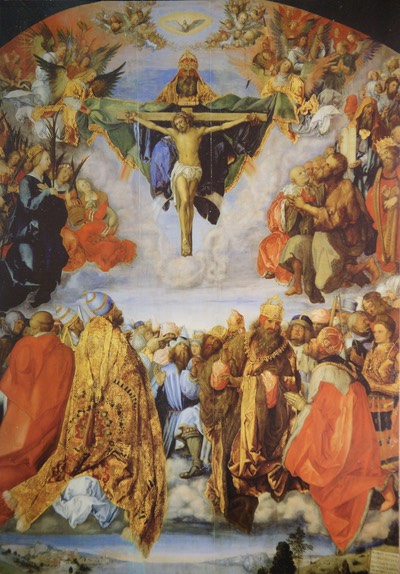
The comforting promise of All Saints is that, by God’s grace, I might meet my grandmothers in Heaven. The startling possibility is that Frank and Jaruzelski might be there too. The idea of Sapieha and Frank, John Paul and Jaruzelski, together at the heavenly banquet is not appealing to me now. But if they are there, keeping close to those heroes, then I would hope to join them, in the company of the improbably blessed.
